You are monitoring the launch of a critical new product feature. The dashboard shows “New Sign-ups” tracking steadily against the goal. You report the success to the executive team: “Growth is stable. We are on track.”
Two hours later, the Head of Customer Support pings you. “Why are we getting flooded with tickets? Nobody can create an account.”
You panic. You look at the dashboard. The numbers still show steady growth. You dig into the code. You fire off some pings and make a few phone calls.
You realize your metric counts registration button clicks. But Engineering pushed a site update earlier in the week that changed the API call behind that button. The button clicks, the event fires, but the database write fails 20% of the time.
You measured intent (the click) rather than reality (the user).
In that moment, your dashboard goes from being a “single source of truth” to a liability. It does not matter that your code was correct. It does not matter that you visualized the data beautifully. You did not earn a full understanding of the system you were measuring.
If you had reviewed this logic with a peer from Engineering, they would have caught this instantly. They would have told you about the API change. But because you were busy and your leadership wanted an update, you chose to go it alone and worked in a silo.
Data teams often operate like this. You ship charts, tables, and models as fast as requests come in.
This is a losing strategy. In the world of high-stakes consulting, sending a client a slide with a misleading metric is a fireable offense. Consultants know that accuracy is not a “nice to have.” It is the product. It is your reputation.
To survive, top-tier consulting firms use a process called “Blue Teaming.” It is a rigorous, adversarial peer review designed to catch errors—both technical and logical—before they leave the building.
You must adopt this immediately.
The Core Concept
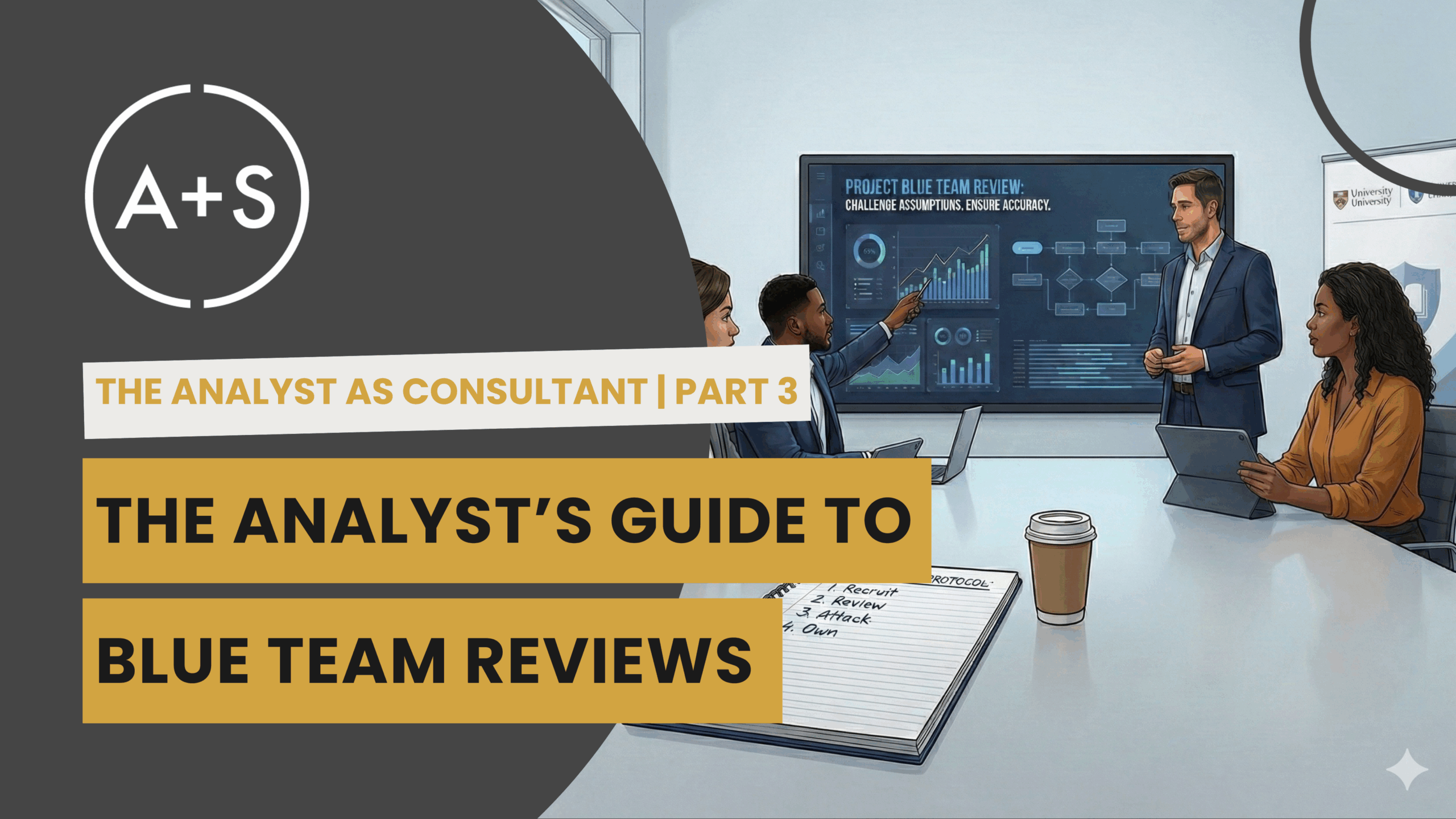
The concept of the “Blue Team” comes from the military, but in the context of professional services, it is your quality assurance firewall. A Blue Team is not a casual chat. It is a structured engagement where you invite a group of peers—people who are not involved in your day-to-day project—to review your work.
The objective is specific: to identify risks and increase the certainty of success.
Most analysts treat Quality Assurance (QA) as a solo activity. You write the code, look at the output, nod your head because it “looks about right,” and hit send. Analysts often view this as the height of professionalism: “If I’m good, my work will always be right.”
But this is amateur behavior. You are too close to the data. You understand the nuance of your own logic, so your brain fills in the gaps that a stakeholder (or a customer) will stumble over.
The Blue Team solves this by introducing the “Outsider Perspective.”
The ideal Blue Team involves a mix of skills. As the introduction illustrated, a Blue Team that included one engineer would have saved you from the “button click” disaster. They bring domain knowledge you lack.
Crucially, the Blue Team operates on a specific ground rule: They make suggestions, not mandates. They are not there to rewrite your code or take over your project. They are there to challenge your thinking. They highlight the risks you missed.
You, the project lead, retain the discretion to accept or reject their feedback. This dynamic lowers defenses. It is not a performance review. It is a safe harbor to break the dashboard before the client breaks it.
The Strategic Framework
You cannot wait until the project is finished to start your review. If you find a foundational error in your logic on the day of the presentation, it is too late. You need to institutionalize quality using a forward-looking approach. This framework rests on three pillars.
1. The Preparation Protocol A Blue Team review fails if the reviewers walk in blind. You must respect their time by preparing a briefing. In consulting, you never hold a review without sending pre-reading materials.
This includes the original proposal or stakeholder request and the current draft of the deliverable. Your reviewers need to know what expectations have been set. The first question a Blue Team asks is not “Is this chart pretty?” It is “Does this deliverable achieve what was promised?” You must map your output to the client’s expected results. If you cannot draw that line, the work is already flawed.
2. The Assumption Challenge Data analysis is built on assumptions. You assume the data source is clean. You assume the event trigger matches the database entry. You assume the stakeholder understands the acronyms.
The Blue Team’s role is to attack these assumptions. Because they are outsiders, they do not know your shorthand. They will look at your “Sign-up” metric and ask how you defined it. When you explain it is based on a front-end event, the engineer in the room will flag the risk. You would never have caught that because you have been looking at the query for three weeks. They catch it in two minutes.
3. The Risk Assessment Every data project carries risk. There is the risk of technical inaccuracy, but there is also the risk of misinterpretation. A technically accurate chart can still be misleading.
The Blue Team evaluates the “Look and Feel” and the logical conclusions. They look for “chart crimes” like truncated axes that mislead the eye. They assess whether your recommendations logically follow from the data presented. They act as a proxy for a skeptical executive. If they can poke holes in your narrative, your stakeholder definitely will.
The Analyst’s Playbook
You do not need a massive QA department to do this. You need a process. Here is how you implement the Blue Team protocol for your next high-stakes analysis.
1. Recruit Your Blue Team (The Skill Mix) Do not just grab the person sitting next to you. Select 3-4 people with a specific mix of skills.
- One Technical Expert: Another analyst to check the SQL/Python.
- One Domain Expert: Someone from Engineering, Product, or Finance who understands the underlying system.
- One or More Outsiders: Colleagues who know nothing about the project to test clarity.
This mix ensures you catch the API change, the SQL error, and the confusing label.
2. Send the Briefing (The Pre-Read) 24 hours before the review, send an email to your Blue Team. It must include:
- The “Ask”: What exactly did the stakeholder request?
- The Context: Why does this matter? What is the business timeline?
- The Deliverable: The link to the dashboard, report, or slide deck.
- The Known Issues: Be honest about what you are still fixing.
3. Run the Agenda Do not let the meeting become a chaotic brainstorming session. You own the agenda.
- Minutes 0-5: Brief Engagement Background. Recap the scope and objectives.
- Minutes 5-10: Walk through the deliverable. Do not explain away the flaws. Let the work stand on its own.
- Minutes 10-25: Two-way feedback. This is where they tear it apart.
- Minutes 25-30: Next steps. Summarize the risks they found.
4. Review The Story To ensure your narrative fits your stakeholders’ needs, ask these specific questions:
- “If you read only the slide ledes, do you get a coherent story?”
- “Is the ‘So What?’ clear on every slide?”
- “Why might any of our insights be wrong?”
- “Are our recommendations supported by the data we presented?”
- “Are our visualizations intuitive, or do I have to work hard to understand them?”
5. Wrap & Move On (Quickly!) After the meeting, you do not need to publish minutes. This is an internal quality control check. Take their feedback. Decide which suggestions improve the product and which are out of scope. Make the changes quickly and prepare to deliver the improved product to your stakeholders.
Final Thoughts
Quality is not about perfectionism. It is about professional reliability. In the data profession, your output determines the direction of the business. If your compass is broken, you steer the ship into the rocks.
You will feel resistance to this process. You will think you do not have time for a peer review. You will feel vulnerable letting others critique your unfinished work.
You must get over this.
The embarrassment of a peer finding a mistake is temporary. The damage of a stakeholder finding a mistake is permanent.
Institutionalize this discipline. Make the Blue Team review a non-negotiable step in your delivery cycle. When you do, you stop being the analyst who “might” be right and become the consultant who is “always” right.
Keep Analyzing!