We have spent four weeks sharpening your edge, helping you transform from a tactical analyst into a strategic consultant.
But you must face a final, cold reality: The best analysis in the world will fail if the client’s environment rejects it.
A steering wheel is useless if the road is washed out. If you don’t account for the organizational friction and the skill gaps ahead, you aren’t a navigator—you’re just an observer of the wreck.
The “Actionable Deliverable” is not a deck or a dashboard. It is a system of adoption.
To deliver true value, stop obsessing over the elegance of your code and start obsessing over the friction of the client’s reality. You are not just building an engine; you are re-engineering the road it drives on.
The Strategic Framework: The Adoption Infrastructure
Large organizations have an “immune system” designed to kill change. Your deliverable is a foreign object. Unless you wrap it in the right protocols, the organization will attack it and eventually bury it.
A project is not “done” when the code runs. A project is “done” when the organization has been reshaped to sustain it.
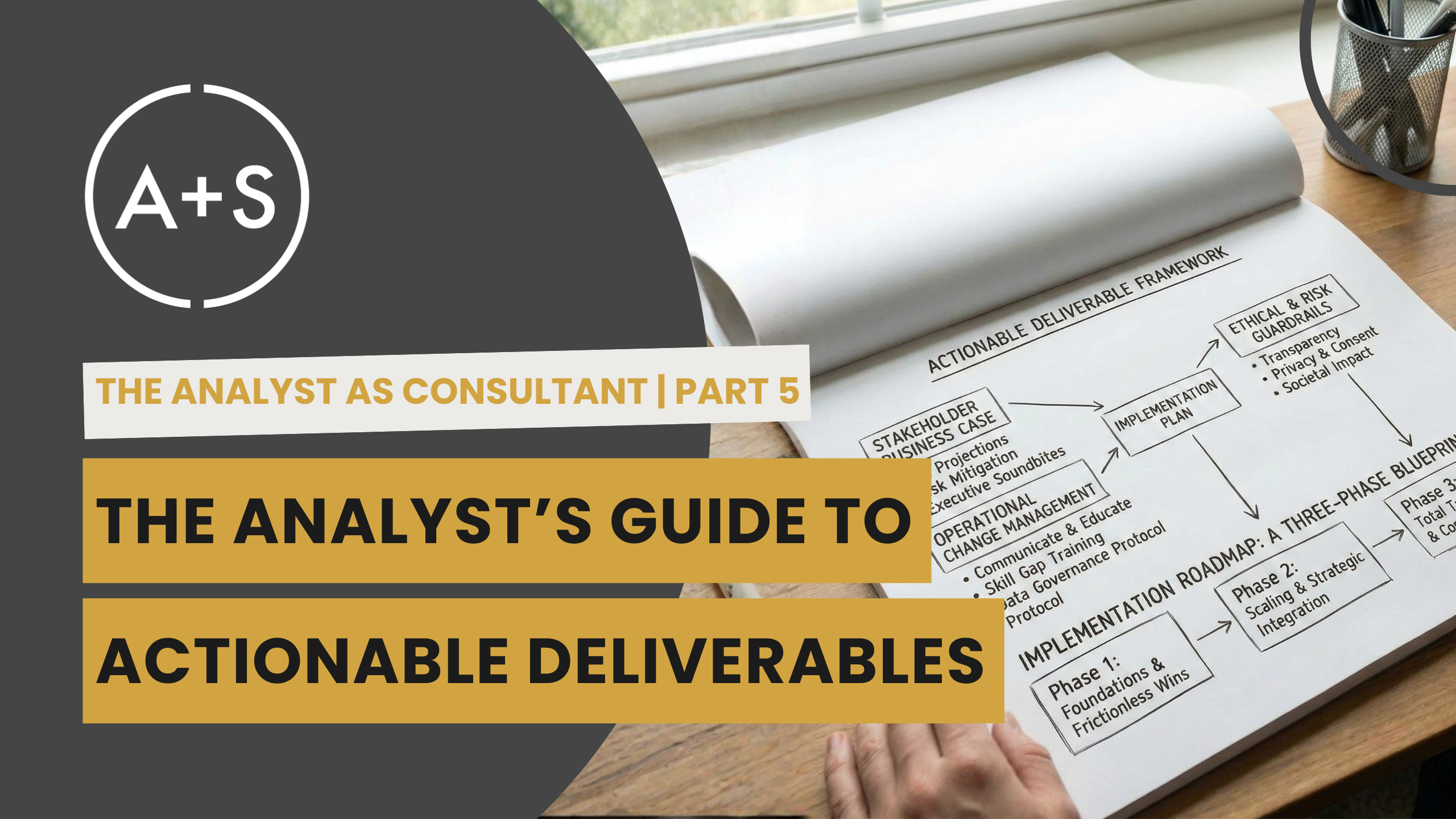
To turn a one-off project into a permanent transformation, your deliverable must address three environmental layers.
1. The Stakeholder Business Case Your client is rarely the final decision-maker. They are an internal champion who must sell your work to their bosses. If you don’t give them the ammunition to win that fight, you both lose.
- The Bulletproof Case: Provide the specific ROI calculations, risk data, and “Executive Soundbites” they need to socialize the change.
- The “Why Now?”: Define the cost of inaction. Make the status quo more painful than the transition.
2. Operational Change Management Change creates friction. Friction creates resistance. You must preemptively lubricate the gears:
- Overcoming Resistance: Use inclusive change management. If the frontline staff feels “analyzed” rather than “empowered,” they will sabotage the project as soon as you hand it off.
- The Skill Gap: Your tool is useless if the team can’t wield it. Your deliverable must include a training or hiring roadmap to close the skill gaps your recommendations require.
- Data Governance: An engine dies on dirty fuel. You must leave behind a structured protocol for data hygiene. If stakeholders can’t trust the data, they’ll never trust your recommendations.
3. The Ethical & Risk Guardrails A “successful” deliverable can become a liability if it lacks a moral compass. You must build in the following:
- Transparency: Ensure the “black box” is interpretable. If a human cannot explain why a recommendation was made, the work is a liability.
- Privacy & Consent: Hard-code compliance into the workflow. Security is not an afterthought; it is a feature.
- Societal Impact: Ensure your recommendations (especially any involving the use of AI) do not perpetuate inequity or harm. Where impacts are unavoidable, arm your client with strategies to mitigate those impacts.
The Implementation Roadmap: A Three-Phase Blueprint
Do not just show the client the “To-Be” state. A vision without a path is just a hallucination. You must provide a roadmap that bridges the gap between the status quo and execution.
Phase 1: Foundations and Frictionless Wins The first phase establishes a clean digital starting point. By identifying “value pockets” where high-quality data already exists, you can run targeted experiments to prove the concept without massive overhead. This phase gathers the irrefutable evidence needed to build trust and justify a larger bet.
Phase 2: Scaling and Strategic Integration Once proven, the focus shifts to expanding the footprint. This involves moving the project from the periphery to the center, appointing internal champions to bridge the gap between technical teams and business units. Here, the goal is to standardize workflows and build proprietary internal competencies.
Phase 3: Total Transformation The final phase culminates in full integration into daily operations. The project is no longer a “new initiative” but a core function that automates touchpoints and learns from every outcome. This requires a cultural commitment to a new way of working, where feedback loops are institutionalized and the organization makes high-stakes decisions with unshakeable confidence.
Final Thoughts: The Complete Consultant
We have completed the journey. You are no longer an analyst who “does data.” You are a consultant who engineers outcomes.
- You have set and managed Expectations to bring value.
- You have embraced Hypothesis-Driven Analysis to efficiently find truth.
- You have adopted the Blue Team Protocol to ensure excellence.
- You have become a PMO of One to diminish risk.
- And now, you have learned the Adoption Infrastructure to ensure impact.
The transition is complete. You have moved from the back office to the boardroom. You don’t just provide answers; you provide the map, the engine, and the steering wheel. You have the tools to change not just numbers, but organizations.
Go drive the business.
Keep Analyzing!