I have a profound love for brand science.
To me, there is something deeply satisfying about peeling back the layers of a global icon to reveal the clinical, mathematical scaffolding that supports it.
Yet it is remarkably easy for analysts to get confused when designing a brand because they get lost in “shiny objects.” They find themselves captivated by the beauty of advertisements, the sleekness of product design, and the intoxicating limelight of cultural relevance. While the art of the brand is vital, it frequently obscures the underlying mechanics.
Brand is far too important to be left to “vibe” alone. As a brand strategist, your task is to reduce the nebulous to the manageable. By applying the science of brand, you transform a creative output into a rigorous strategic architecture that any company can manage.
Brand Science Drives Equity
Brand equity is not an accident of inspiration; it is the deliberate synthesis of Relevance, Differentiation, and Sustainability. When you anchor your strategy in these three pillars, you are no longer guessing at growth; you are engineering a brand that is built to win.
The 3 Non-Negotiable Pillars of Brand Science
Successful brands are built upon 3 structural characteristics that allow them to rise above the “sea of sameness” in their market:
- Relevance (The Right to Play): A brand is useless if it is not relevant. Relevance is about dominating a subcategory so completely that competitors become an afterthought. To even enter the consideration set, your brand must deliver on the category “Must-Haves” at a 100% success rate. If you aren’t relevant, you don’t just lose share; you lose the right to compete.
- Differentiation (The Price vs. Value Gap): This is the engine of Irrational Margin. Differentiation occurs when a brand claims a unique “Meaning” that peers cannot replicate. While Hermes owns “Timeless Artisanal Heritage,” Burberry differentiates through its “Functional British Explorer” narrative. These brands do not just sell products; they provide self-expressive signals that allow perceived value to scale exponentially faster than the Cost of Goods Sold (COGS).
- Sustainability (The Economic Moat): Sustainability is a consistent commitment to protecting your relevance and differentiation. It ensures your architecture withstands competitive forces and navigates crises. This requires establishing proof points across the customer journey—from pre-purchase promises to post-purchase reality—to build lasting trust.
The 2 Paths to Profitability
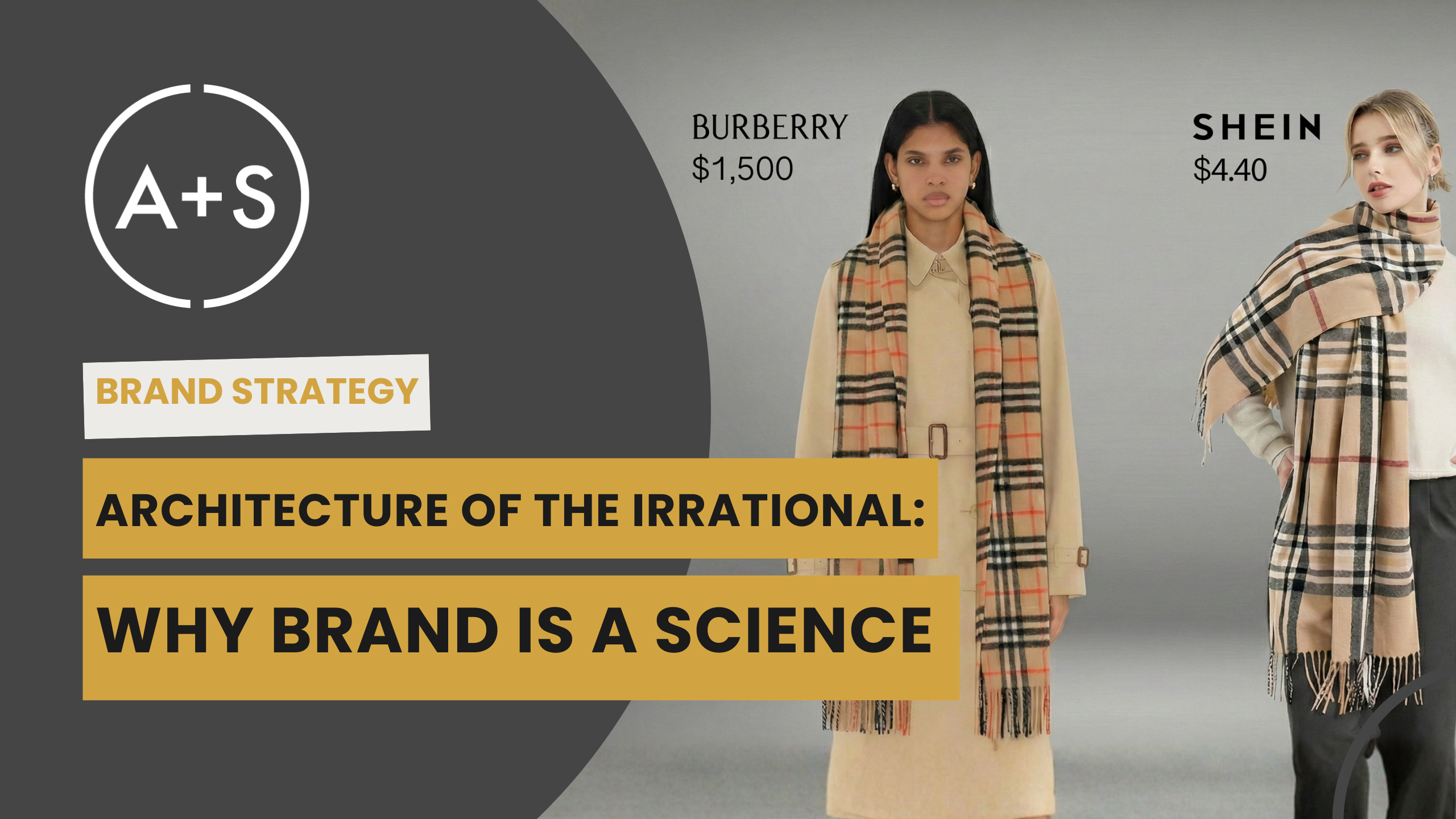
Your choice of brand architecture dictates your path to economic survival. Consider the contrast between a $4.40 scarf from Shein and a $1,500 scarf from Burberry.
- Broad Market Accessibility (The Shein Approach): A volume-based logistics play. Shein wins during the Purchase phase of the consumer journey by optimizing for price and access. They move massive amounts of product with thin margins.
- High-Margin Exclusivity (The Burberry Approach): A value-based storytelling play. Burberry wins in the Post-Purchase phase, where the scarf serves as a status badge. They command 300 times the price because their differentiation creates a massive gap between cost and perceived value.
The choice between these paths is a clinical decision based on the size and accessibility of your market. You choose high-margin exclusivity when your differentiation is so profound that you can thrive by capturing high profit from an exclusive audience. Conversely, you lean into broad market accessibility when the market is so vast that thin margins become mountains of profit through sheer scale.
However, without aligning your brand architecture and your market dimensions, you risk pursuing a volume strategy in a niche market or a luxury strategy where no premium exists.
Market Implications: The Architecture of Profit
We align structural pillars to market dimensions because the intersection of brand architecture and market sizing is where creative audacity meets the unyielding math of profit:
- TAM (Total Addressable Market) – Relevance is the Ceiling: Your brand’s Relevance determines your right to play. If you fail to meet the “Must-Haves” of the category, you are excluded from the TAM entirely.
- SAM (Serviceable Available Market) – Reach is the Filter: This is the portion of the TAM reachable through your business model and geography. It represents the “Available” pool of consumers who have the access and means to buy you.
- SOM (Serviceable Obtainable Market) – Differentiation is the Tie-Breaker: This is the cohort you capture today. Your Differentiation is the “Reason to Choose” that converts a lead in the SAM into a transaction in your SOM.
Sustainability ensures that your differentiation isn’t a flash in the pan, but a long-term economic moat that defends your margin against competitors and crises.
Consumer Benefits: The Strategic Glue
Consumer benefits serve as the strategic glue that turns abstract pillars into reality. You must master the 3 distinct types of benefits that ladder up to a powerful brand promise:
- Functional Benefits (The Relevance Filter): Rational foundations. If the product fails the basic “Must-Haves” (a scarf that warms), you never enter the consideration set.
- Emotional Benefits (The Preference Engine): How the brand makes the consumer feel (e.g., fashionable, sophisticated). This is the first step toward moving away from commodity pricing and narrowing the SAM into your SOM.
- Self-Expressive Benefits (The Margin Extractor): How the brand signals self-image (e.g., “I have arrived”). This is the primary driver of Irrational Margin. A consumer isn’t paying $1,500 Burberry for cashmere; they are paying for the status signal.
As a brand strategist, you must ensure these benefits are curated across the Consumer Decision Journey (CDJ). Sustainability results from consistently delivering on the brand’s promises and defending them against “reasons not to buy.”
Theory to Practice
To apply this Art+Science lens, complete this mental exercise on your brand this week:
- Audit the “Must-Haves”: List the top 3 functional requirements a consumer needs to consider your brand. Are you meeting them with 100 percent consistency?
- Map the Ladder: Identify key functional, emotional, and self-expressive benefits your brand provides. If you can only name functional benefits, you are likely competing on price alone.
- Verify the Economics: Review your SOM targets. Is your current level of differentiation high enough to justify your price premium?
- Refine the Cues: Audit 5 random touch points in your customer journey (such as your website, a customer service script, or an email header). Do they all project the quality that builds sustainability?
The complexity of a brand is a block of stone; the science of its architecture is the tool that finds the masterpiece inside.
Until next week, Keep Analyzing!