Imagine stepping into a room full of executives eager to hear the results of the past quarter’s marketing efforts. The marketing team steps up first, proudly presenting a glowing dashboard with positive brand perception numbers. Customer satisfaction scores are high, clients return more often than not, and existing customers constantly recommend your company.
As the glow fades, you step up to present your analysis. In spite of the stellar CSAT scores, market share is steadily dropping quarter after quarter. While a quiet confusion spreads through the boardroom, you begin to explain the crux of your analysis: Brand sentiment is at an all-time high, but brand relevance is in decline.
The distinction between relevance and sentiment is a crucial strategic concept that often leaves executives, marketers, and analysts alike stumped.
- Brand Sentiment speaks to the goodwill a brand builds with its customers. It ensures that current clients enjoy engaging with your product and spread positive word-of-mouth.
- Brand Relevance describes how easily and how often your brand comes to a buyer’s mind at the exact moment of purchase. It dictates your top-of-funnel reach and determines how many new customers you can acquire.
A relevant brand with strong positive sentiment wins. If your brand has high relevance but low sentiment, you will typically struggle to retain the customers you attract. But if you have low relevance, your brand perception doesn’t matter. You could provide exceptional customer experiences, but if your product is never in the consideration set, you will remain a great product that nobody ever buys.
In this week’s newsletter, we examine why high CSAT alone can trap a business, and how to balance sentiment with mental availability to drive real growth.
Relevance vs. Sentiment
As analysts, we are often trained to treat survey scores as the ultimate proxy for brand health. But traditional CSAT and NPS metrics suffer from well-documented structural flaws. Surveys are highly vulnerable to social desirability bias, automatic “5-star” conditioning, and situational mood swings.
More critically, a top-tier rating on a post-purchase survey merely captures a snapshot of past satisfaction. That 9 or 10 on your NPS survey does not guarantee future buying behavior or long-term loyalty. To drive real growth, a brand must do more than please existing buyers; it must build consideration across the entire market.
A brand acts as a mental shortcut in a crowded marketplace. For a consumer to choose your brand, you must clear two important hurdles:
- Awareness: You must deliver on the baseline functional requirements that earn your brand the right to enter the consumer’s consideration set. First, they must know you exist—this is the idea of simple “awareness” measures. Next, they must know that your product can meet their needs—this is a major component of your brand positioning.
- Consideration: When a specific purchase trigger occurs (e.g., “I need a quick lunch today” or “I need secure cloud storage”), your distinctive brand attributes must be retrieved from memory. First, customers must trust that you deliver on their needs as well as (if not better than) your competition to earn your right to compete. Next, your perceived value must justify your price point—which is the mental calculation they’ll complete that weighs the benefits you provide against all the resources they’ll need to expend to purchase your product (most prominently money and time).
Successfully crossing these hurdles leads to purchase intent. If competitors beat you here in awareness or consideration, your pristine 95% CSAT score remains invisible because your target market intends to purchase your competitors’ products, not yours. You’ll continue to be the low-growth, “best-kept secret” on the market.
The Relevance-Sentiment Matrix
To diagnose brand health, we can map Brand Relevance (Mental Availability) against Brand Sentiment (Customer Experience) across a 2×2 matrix:
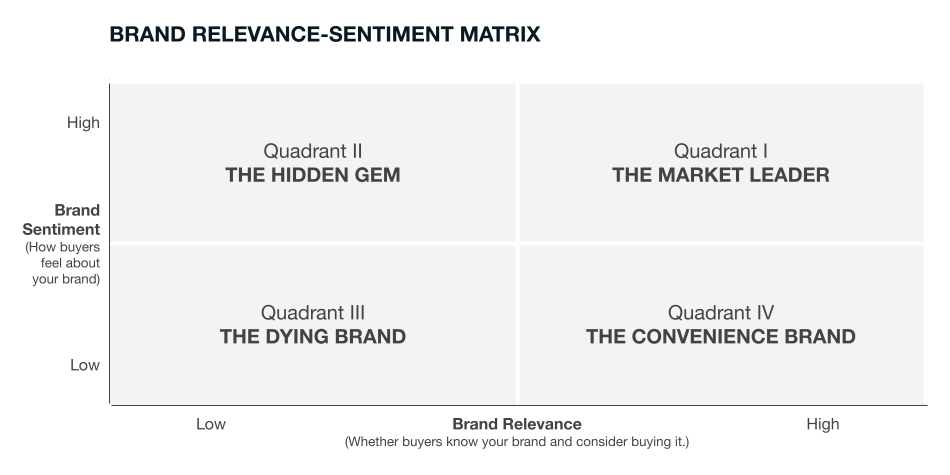
- Quadrant I: The Market Leader (High Relevance, High Sentiment): The gold standard. The brand is top-of-mind across major purchase triggers and consistently delivers on its brand promise.
- Quadrant II: The Hidden Gem (Low Relevance, High Sentiment): The classic “CSAT Trap.” Existing customers adore the product, but the brand lacks distinctive cues or mental reach. Growth stalls because prospective buyers simply never think of the brand when purchase needs arise.
- Quadrant III: The Dying Brand (Low Relevance, Low Sentiment): The brand lacks distinctive memory anchors and fails to satisfy buyers, leading directly to market decay and irrelevance. No matter its history or heritage, when a brand finds itself in this position it has two paths: reinvent or die.
- Quadrant IV: The Convenience Brand (High Relevance, Low Sentiment): Highly visible and instantly recalled, but plagued by operational friction or service complaints. While high relevance keeps customer acquisition strong, unaddressed sentiment issues risk long-term equity erosion. These are the “I can’t believe I’m buying this again” brands.
Theory to Practice: 4 Steps to Balance Relevance and Sentiment
As an analyst, your mandate is to bridge the gap between surface survey feedback and true behavioral outcomes. Here is your tactical protocol for balancing relevance and sentiment this week:
- Audit Category Entry Points (CEPs): Map the specific situational triggers, buying occasions, and needs that prompt a customer to enter your category. Measure your brand’s unaided awareness against competitors across each specific trigger rather than relying on generic brand awareness.
- Pair Sentiment Surveys with Behavioral Signals: Never analyze CSAT or NPS in a vacuum. Supplement survey snapshots with observable lagging indicators—such as customer retention rates, repeat purchase frequency, digital micro-conversions (e.g., app engagement, cart additions), and Customer Lifetime Value (CLV).
- Track Voice of the Customer (VoC) Data: Deploy AI-powered topic modeling and social listening to analyze unsolicited customer conversations across social channels, reviews, and support interactions in real time. This uncovers genuine customer sentiment without survey prompting.
- Prioritize Relevance Over Sentiment: When drops in sentiment metrics occur, see them as a threat to relevance instead of brand perception alone. Investigate signals that point to friction at specific touchpoints in the customer journey (e.g., checkout or post-purchase onboarding), and ensure the brand resolves the root cause of the issues rather than applying a simple messaging patch.
Final Thoughts
Customer satisfaction is table stakes in business. It keeps current buyers satisfied and coming back. But brand relevance is the true engine of growth.
Your role as a strategist is not just to report high CSAT scores, but to make sure your brand builds long-lasting, distinctive relevance that wins the market battle before your buyer ever reaches the checkout counter.
Until next week, Keep Analyzing!