Over the past 4 weeks, we explored how the deployment of high-stakes AI systems requires a moral code that moves beyond a simple desire for optimization. We established that machines operate solely on formal mathematical directives and lack moral agency. Because of this, the responsibility for protecting human dignity, critical thinking, and workplace capabilities rests entirely on the professionals designing and deploying these systems.
Understanding utilitarianism, deontology, and virtue ethics in isolation is insufficient. Without a unified system, data science naturally defaults to utilitarian optimization, which uses aggregate metrics to hide distributional injustice. To safely govern AI and protect human judgment, leaders must fuse all 3 frameworks into a single operational standard mapped to the Human-AI Nexus framework—establishing harm tripwires for Operators, duty-based brakes for Investigators, deliberate review friction for Designers, and cognitive safeguards for Innovators.
The Default Trap of Utilitarian Optimization
Before we can implement solutions, we must understand why tech platforms naturally default to utilitarian optimization. Because AI is fundamentally quantitative and outcomes-focused, leaders routinely view moral responsibility through the narrow lens of aggregate performance.
Under this corporate calculus, if the overall performance metric is optimized and demographic disparity remains below an acceptable threshold, the launch of any new feature is considered morally justified. This reliance on statistical averages creates a severe case of distributional injustice. When an organization focuses exclusively on maximizing average well-being, severe harms inflicted upon minority populations or vulnerable groups are mathematically treated as acceptable tradeoffs for aggregate utility.
Upholding Deontological Boundaries
To escape the trap of viewing human beings as mere numbers, strategic analysts must look to deontology, a moral framework centered on human dignity, fundamental duties of care, and non-negotiable boundaries of transparency.
Deontology demands that the dignity and autonomy of employees and the public take priority over corporate profit or market dominance. Respecting human dignity requires organizations to fulfill their fundamental duties of care before pursuing secondary goals like financial growth. By focusing on absolute moral rules rather than calculating outcomes alone, organizations ensure that technological progress remains safe, transparent, and accountable.
Preserving Cognitive Friction Through Virtue Ethics
While rules and boundaries establish safety, true algorithmic governance requires evaluating the human element through virtue ethics. Bypassing cognitive effort eliminates the human input required to build critical thinking and professional character. True expertise is not formed by receiving an instant answer; it is forged by working through complex problems.
Therefore, organizations must ground technology integration in virtue ethics by maintaining intentional workflow friction. This friction ensures professionals do not become entirely reliant on statistical pattern matchers, which replace active reasoning with superficial imitation and erode personal accountability.
Theory to Practice: Mapping the Human-AI Nexus
To translate these three ethical frameworks into a concrete action plan, leaders can map guardrails directly to workflow demand using the Human-AI Nexus framework.
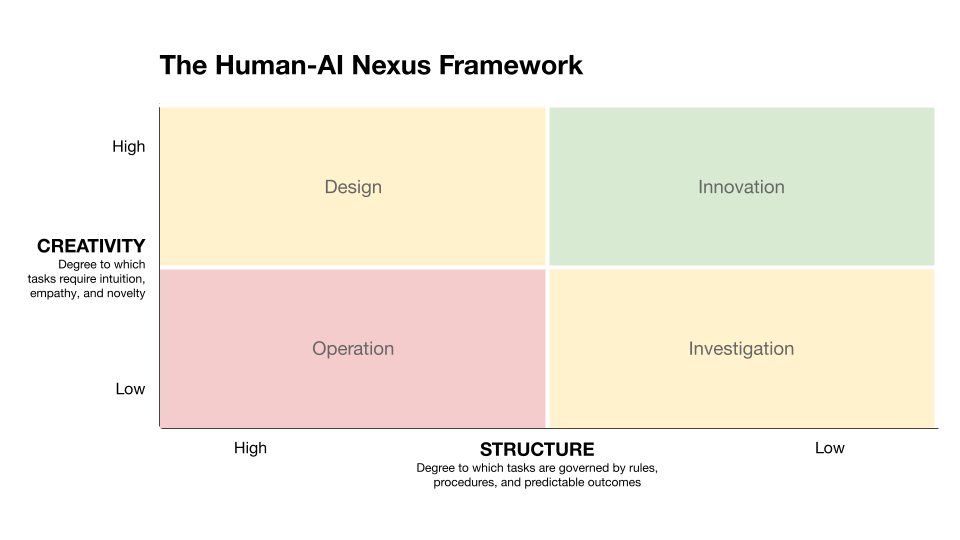
The framework categorizes tasks based on their inherent demand for structure and creativity, clarifying where AI should operate under full automation and where humans must maintain active cognitive leadership. Because AI’s ethical risks vary depending on whether a task requires deep human empathy or strict rule-following, mapping these guardrails ensures that organizations apply the appropriate ethical boundary to each specific workflow:
- Set harm tripwires for Operators (High Structure, Low Creativity): Tasks with low creative demand and high operational structure are prime candidates for full automation. Because machine learning defaults to utilitarian optimization, automated algorithms will prioritize speed and scale over safety if left unchecked. Leaders must establish hard tripwires for harm: if a feature causes severe harm to even 1 percent of a vulnerable group, the system must automatically pause and require human intervention.
- Enforce duty-based brakes for Investigators (Low Structure, Low Creativity): In complex, non-routine analysis, AI excels at processing data, but ultimate human judgment remains crucial. Because these roles operate in high-stakes ambiguity, AI lacks the fundamental moral duty to public safety required to make the final call. Ground these workflows in deontology by programming automatic deployment brakes into software pipelines, ensuring analysts uphold non-negotiable boundaries of transparency and public safety before releasing findings.
- Implement deliberate friction for Designers (High Structure, High Creativity): Roles blending human creativity with established methodologies face high potential for AI augmentation. Because these workflows rely on templates, professionals can easily become over-reliant on AI generation and skip the cognitive struggle required to build domain mastery. To avoid this bootstrapping problem, leaders must introduce mandatory review pauses where team members verbally defend the logic, assumptions, and data sources behind AI outputs.
- Protect the cognitive capacity of Innovators (Low Structure, High Creativity): Roles demanding exceptional human intuition and abstract creative thought are the least susceptible to AI replacement. Preserve the human input required for critical thinking by evaluating these professionals on their depth of domain understanding rather than speed or output volume, ensuring AI remains a tool for early-stage synthesis rather than a replacement for active reasoning.
Until next week, keep analyzing!